
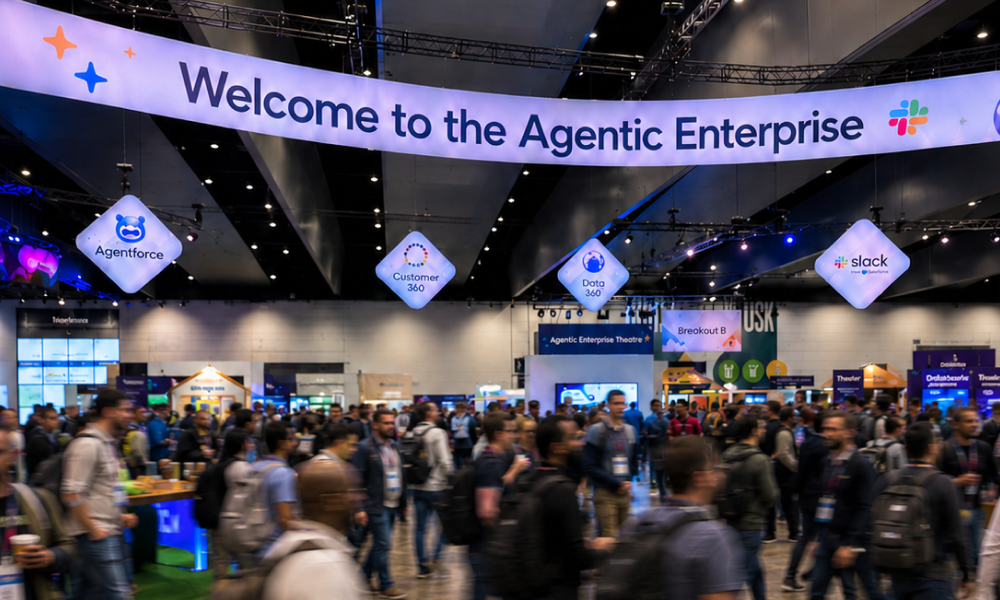
Melbourne Agentforce World Tour 2026: What Nonprofits Can Still Take Away
For many nonprofits, Melbourne Agentforce World Tour 2026 may not have looked like an obvious must-attend event at first glance.
A lot of the agenda focused on commercial examples, including retail, insurance, small business growth, service operations, Slack productivity, and AI-powered customer experiences. For nonprofit teams already stretched with all of the end-of-financial-year processes happening, it would be easy to look at the program and think, “This is not really for us.”
That is understandable.
But while there may not have been a strong nonprofit-specific focus, the themes behind the sessions were highly relevant for charities, not-for-profits, schools, membership organisations, faith-based organisations, and community groups using Salesforce.
The real value for nonprofits was not in copying retail or insurance use cases. It was in understanding how Salesforce is positioning AI agents, connected data, Slack, Marketing, Service, and Voice on one trusted platform, and what that could mean for lean teams trying to do more with limited resources.
The big message: AI is only useful when it is connected to your data
One of the key themes across Agentforce World Tour was the connection between humans, data, and agents.
For nonprofits, this matters because AI is only as useful as the information it can safely and accurately work with. An AI agent that cannot see the right donor, payment, campaign, membership, or case information will only give generic answers. An AI agent connected to clean Salesforce data can start to support real work.
That might include helping staff find donor history, summarise supporter interactions, surface campaign performance, answer internal Salesforce questions, or guide team members through common processes.
The lesson for nonprofits is simple: before thinking too far ahead about AI, it is worth asking whether your Salesforce data is structured, consistent, and trusted enough to support it.
Good AI starts with good data.
Start with a proof of concept, not a full AI transformation
One of the most practical sessions focused on brainstorming and blueprinting a first Agentforce proof of concept.
This is a useful mindset for nonprofits. AI can feel overwhelming when it is presented as a major transformation project. Most nonprofit teams do not have the time, budget, or internal capacity to rebuild how they work overnight.
A proof of concept gives organisations a safer and more manageable starting point.
Rather than asking, “How do we use AI everywhere?” nonprofits can ask:
What is one high-value, repeatable process that takes too much staff time?
For example, a nonprofit might explore a proof of concept around:
Answering common donor or supporter enquiries
Helping staff find payment, receipt, or donation information in Salesforce
Summarising supporter history before a call
Assisting with campaign follow-up tasks
Helping service teams triage incoming requests
Supporting internal staff with Salesforce how-to questions
Surfacing grant, program, or fundraising data faster
The strongest Agentforce use cases are likely to be the ones that reduce manual work, improve response times, and help staff spend more time on meaningful human interactions.
Small business lessons still apply to nonprofit teams
Another session explored how small and medium businesses can use AI as a growth catalyst, helping a smaller team operate with the efficiency of a much larger one.
While the example was commercial, the challenge is familiar to nonprofits.
Many nonprofit teams are small. Staff often manage multiple roles. A fundraising manager might also be responsible for donor care, events, campaigns, reporting, website updates, and board reports. Admin teams may be managing payments, receipts, reconciliation, supporter records, and compliance with limited resources.
For nonprofits, the question is not usually, “How do we scale for profit?”
It is, “How do we increase capacity without burning out our people?”
This is where AI agents may become valuable. Not as a replacement for staff, but as a way to reduce repetitive admin, speed up access to information, and make day-to-day work easier.
A two-week order process becoming a two-day process may come from a business example, but the same thinking can apply to nonprofit operations. What supporter, payment, admin, or reporting process could be shortened with better data, automation, and AI support?
Slackbot could reduce context switching for busy teams
The Slackbot session was one of the more practical examples for teams that already use Slack or are exploring better internal collaboration.
The session highlighted how Slackbot can help teams find information in channels, query Salesforce using natural language, build reusable AI-powered skills, and capture insights in structured canvases.
For nonprofits, this could be especially useful where information is spread across multiple places: Salesforce records, email inboxes, Slack messages, spreadsheets, campaign plans, support notes, and staff knowledge.
Imagine a fundraising team being able to ask a question like:
“How many major donors from Victoria gave last financial year?”
Or a supporter care team asking:
“Show me recent payment issues from this donor before I call them back.”
Or a campaigns team capturing meeting notes, next steps, donor feedback, and campaign ideas in a structured canvas that can be shared across the team.
The value is not just speed. It is reducing the amount of time staff spend switching between tools, searching for information, and asking colleagues where something is stored.
Agentforce Marketing, Service, and Voice need a nonprofit lens
The event also highlighted Agentforce Marketing, Service, and Voice through industry demos.
Again, retail and insurance examples may not feel directly relevant to nonprofits. But the underlying ideas are worth paying attention to.
For nonprofits, Agentforce Marketing could eventually support more personalised donor and supporter journeys. This might include helping tailor communications based on giving history, campaign engagement, event attendance, membership status, or volunteer involvement.
Agentforce Service could help supporter care teams respond faster to common questions, such as donation receipts, recurring payment updates, event registrations, membership renewals, or tax statement requests.
Agentforce Voice could become relevant for organisations handling phone-based supporter enquiries, service intake, or community support calls.
The nonprofit opportunity is not to automate every interaction. It is to use AI carefully where it helps staff respond with more context, consistency, and care.
The nonprofit opportunity: more time for human connection
Nonprofits are built on relationships. Donors, volunteers, members, clients, supporters, and communities all need to feel seen and understood.
That is why AI adoption in the nonprofit sector needs to be thoughtful. The goal should not be to make every process feel automated. The goal should be to remove the manual work that gets in the way of genuine human connection.
If an AI agent can help a staff member find the right donor information faster, that staff member can have a better conversation.
If Slackbot can answer an internal Salesforce question quickly, a team member can keep moving without waiting for help.
If Agentforce can support common admin tasks, nonprofit staff can spend more time on fundraising, service delivery, stewardship, advocacy, and impact.
That is where the real value sits.
Key questions nonprofits should be asking after World Tour
Even if the event was not heavily nonprofit-focused, it raised important questions for any organisation using Salesforce.
Nonprofit teams should consider:
Is our Salesforce data clean and trusted enough to support AI?
Which repetitive tasks are taking the most time from staff?
Where do supporters experience delays or inconsistent responses?
What information do staff regularly struggle to find?
Which processes would be suitable for a small proof of concept?
How can we use AI in a way that supports, rather than replaces, human relationships?
What governance, privacy, and approval steps would we need before using AI with supporter data?
These questions are a useful starting point before investing in any AI tool or Agentforce project.
Final thoughts
Melbourne Agentforce World Tour 2026 may not have been designed specifically for nonprofits, and many organisations may have chosen to skip it for that reason.
But the event still offered valuable insight into where Salesforce is heading.
For nonprofits, the opportunity is to look beyond the commercial examples and focus on the principles: connected data, trusted systems, practical automation, reduced admin, and better access to information.
Agentforce will not solve every challenge on its own. But with the right data, the right use case, and a clear proof of concept, it may help nonprofit teams work more efficiently and create more time for the people and communities they support.
At Payments2Us, we believe technology should make nonprofit work easier, not more complicated. As Salesforce continues to evolve with AI and Agentforce, the most important question for nonprofits is not simply, “What can AI do?”
It is, “Where can AI help our team spend more time on the work that matters most?”
Melbourne Agentforce World Tour 2026: What Nonprofits Can Still Take Away
For many nonprofits, Melbourne Agentforce World Tour 2026 may not have looked like an obvious must-attend event at first glance.
A lot of the agenda focused on commercial examples, including retail, insurance, small business growth, service operations, Slack productivity, and AI-powered customer experiences. For nonprofit teams already stretched with donor engagement, fundraising campaigns, service delivery, reporting, receipting, and end-of-financial-year processes, it would be easy to look at the program and think, “This is not really for us.”
That is understandable.
But while there may not have been a strong nonprofit-specific focus, the themes behind the sessions were highly relevant for charities, not-for-profits, schools, membership organisations, faith-based organisations, and community groups using Salesforce.
The real value for nonprofits was not in copying retail or insurance use cases. It was in understanding how Salesforce is positioning AI agents, connected data, Slack, Marketing, Service, and Voice on one trusted platform, and what that could mean for lean teams trying to do more with limited resources.
The big message: AI is only useful when it is connected to your data
One of the key themes across Agentforce World Tour was the connection between humans, data, and agents.
For nonprofits, this matters because AI is only as useful as the information it can safely and accurately work with. An AI agent that cannot see the right donor, payment, campaign, membership, or case information will only give generic answers. An AI agent connected to clean Salesforce data can start to support real work.
That might include helping staff find donor history, summarise supporter interactions, surface campaign performance, answer internal Salesforce questions, or guide team members through common processes.
The lesson for nonprofits is simple: before thinking too far ahead about AI, it is worth asking whether your Salesforce data is structured, consistent, and trusted enough to support it.
Good AI starts with good data.
Start with a proof of concept, not a full AI transformation
One of the most practical sessions focused on brainstorming and blueprinting a first Agentforce proof of concept.
This is a useful mindset for nonprofits. AI can feel overwhelming when it is presented as a major transformation project. Most nonprofit teams do not have the time, budget, or internal capacity to rebuild how they work overnight.
A proof of concept gives organisations a safer and more manageable starting point.
Rather than asking, “How do we use AI everywhere?” nonprofits can ask:
What is one high-value, repeatable process that takes too much staff time?
For example, a nonprofit might explore a proof of concept around:
Answering common donor or supporter enquiries
Helping staff find payment, receipt, or donation information in Salesforce
Summarising supporter history before a call
Assisting with campaign follow-up tasks
Helping service teams triage incoming requests
Supporting internal staff with Salesforce how-to questions
Surfacing grant, program, or fundraising data faster
The strongest Agentforce use cases are likely to be the ones that reduce manual work, improve response times, and help staff spend more time on meaningful human interactions.
Small business lessons still apply to nonprofit teams
Another session explored how small and medium businesses can use AI as a growth catalyst, helping a smaller team operate with the efficiency of a much larger one.
While the example was commercial, the challenge is familiar to nonprofits.
Many nonprofit teams are small. Staff often manage multiple roles. A fundraising manager might also be responsible for donor care, events, campaigns, reporting, website updates, and board reports. Admin teams may be managing payments, receipts, reconciliation, supporter records, and compliance with limited resources.
For nonprofits, the question is not usually, “How do we scale for profit?”
It is, “How do we increase capacity without burning out our people?”
This is where AI agents may become valuable. Not as a replacement for staff, but as a way to reduce repetitive admin, speed up access to information, and make day-to-day work easier.
A two-week order process becoming a two-day process may come from a business example, but the same thinking can apply to nonprofit operations. What supporter, payment, admin, or reporting process could be shortened with better data, automation, and AI support?
Slackbot could reduce context switching for busy teams
The Slackbot session was one of the more practical examples for teams that already use Slack or are exploring better internal collaboration.
The session highlighted how Slackbot can help teams find information in channels, query Salesforce using natural language, build reusable AI-powered skills, and capture insights in structured canvases.
For nonprofits, this could be especially useful where information is spread across multiple places: Salesforce records, email inboxes, Slack messages, spreadsheets, campaign plans, support notes, and staff knowledge.
Imagine a fundraising team being able to ask a question like:
“How many major donors from Victoria gave last financial year?”
Or a supporter care team asking:
“Show me recent payment issues from this donor before I call them back.”
Or a campaigns team capturing meeting notes, next steps, donor feedback, and campaign ideas in a structured canvas that can be shared across the team.
The value is not just speed. It is reducing the amount of time staff spend switching between tools, searching for information, and asking colleagues where something is stored.
Agentforce Marketing, Service, and Voice need a nonprofit lens
The event also highlighted Agentforce Marketing, Service, and Voice through industry demos.
Again, retail and insurance examples may not feel directly relevant to nonprofits. But the underlying ideas are worth paying attention to.
For nonprofits, Agentforce Marketing could eventually support more personalised donor and supporter journeys. This might include helping tailor communications based on giving history, campaign engagement, event attendance, membership status, or volunteer involvement.
Agentforce Service could help supporter care teams respond faster to common questions, such as donation receipts, recurring payment updates, event registrations, membership renewals, or tax statement requests.
Agentforce Voice could become relevant for organisations handling phone-based supporter enquiries, service intake, or community support calls.
The nonprofit opportunity is not to automate every interaction. It is to use AI carefully where it helps staff respond with more context, consistency, and care.
The nonprofit opportunity: more time for human connection
Nonprofits are built on relationships. Donors, volunteers, members, clients, supporters, and communities all need to feel seen and understood.
That is why AI adoption in the nonprofit sector needs to be thoughtful. The goal should not be to make every process feel automated. The goal should be to remove the manual work that gets in the way of genuine human connection.
If an AI agent can help a staff member find the right donor information faster, that staff member can have a better conversation.
If Slackbot can answer an internal Salesforce question quickly, a team member can keep moving without waiting for help.
If Agentforce can support common admin tasks, nonprofit staff can spend more time on fundraising, service delivery, stewardship, advocacy, and impact.
That is where the real value sits.
Key questions nonprofits should be asking after World Tour
Even if the event was not heavily nonprofit-focused, it raised important questions for any organisation using Salesforce.
Nonprofit teams should consider:
Is our Salesforce data clean and trusted enough to support AI?
Which repetitive tasks are taking the most time from staff?
Where do supporters experience delays or inconsistent responses?
What information do staff regularly struggle to find?
Which processes would be suitable for a small proof of concept?
How can we use AI in a way that supports, rather than replaces, human relationships?
What governance, privacy, and approval steps would we need before using AI with supporter data?
These questions are a useful starting point before investing in any AI tool or Agentforce project.
Final thoughts
Melbourne Agentforce World Tour 2026 may not have been designed specifically for nonprofits, and many organisations may have chosen to skip it for that reason.
But the event still offered valuable insight into where Salesforce is heading.
For nonprofits, the opportunity is to look beyond the commercial examples and focus on the principles: connected data, trusted systems, practical automation, reduced admin, and better access to information.
Agentforce will not solve every challenge on its own. But with the right data, the right use case, and a clear proof of concept, it may help nonprofit teams work more efficiently and create more time for the people and communities they support.
At Payments2Us, we believe technology should make nonprofit work easier, not more complicated. As Salesforce continues to evolve with AI and Agentforce, the most important question for nonprofits is not simply, “What can AI do?”
It is, “Where can AI help our team spend more time on the work that matters most?”